The Guitar Chord Finder shows any of the guitar chords as a shape on the fretboard, with a finger for every dot. A song sheet says Bm7 and your fingers don't know it yet: pick B, then m7, and if the first shape is a stretch, there are others up the neck.
How to Use the Guitar Chord Finder
Pick the root note in the row of notes.
CC#DPick a chord type in the row under it: Major, Minor, 7 and the other most used types.
MajorMinor7The chord shows on the fretboard, with its name as the heading above it.
Click the numbered buttons under the fretboard for other shapes of the same chord. They run from the nut up the neck.
123For any other type, click All chords ›. It lists every type by family, and you can search by name or formula, like m7b5 or b9.
Click Diagrams above the fretboard to see every shape side by side.
Tip: Pick another note and the chord type stays, so C, D and E major are one click each. Click a dot to hear that one note.
How to Read Guitar Chords
The fretboard reads like tablature: the thinnest string, high E, is at the top, and the thickest, low E, is at the bottom. The nut is on the left, and the fret numbers run along the bottom.
The numbers on the dots are your fretting fingers:
- 1 index finger
- 2 middle finger
- 3 ring finger
- 4 little finger
A yellow dot marks a string you play, and an orange one the root note, the note that names the chord. A X means don't play that string:
- note
- root
- X muted
A dot left of the nut is an open string: play it without fretting. A bar across several strings is a barre: one finger, usually the index, presses them all at that fret.
Display switches what the dots show: your fingers, the note names, or the degrees, each note's place in the chord (1 is the root, 3 the third). Each click moves to the next:
 Fingers
 Notes
 Degrees
If you play left-handed, open  Settings and pick
Left Handed to mirror the fretboard.
Upright Chord Diagrams
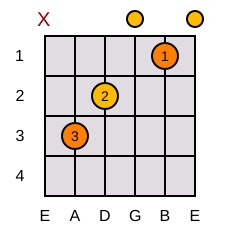
Diagrams draws every shape upright, and so does each chord's own page: the strings run top to bottom with low E on the left, and the frets go down the side. This is the first shape of C major:
How to Play a Guitar Chord
Press each string with the finger the diagram shows, on your fingertip, just behind the fret.
Pick the strings one at a time and listen to each note.
Strum from the lowest string the chord uses, and skip any string marked X.
Click
 Play and compare. On a phone, a swipe up or down over the neck strums the chord too.
With Chord Auto Sound on in Settings, every chord you pick plays by itself.
Common mistake: Strumming before every note rings. If a note buzzes, press harder or move closer to the fret; if it sounds dead, another finger is touching that string.
Beginner Guitar Chords
Start with these eight open chords. Each is the first shape the Chord Finder shows for that chord, and each name below opens the chord's page.
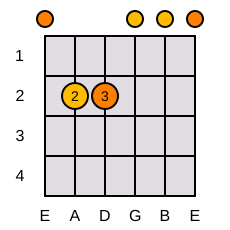
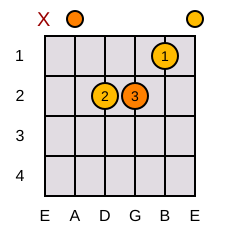
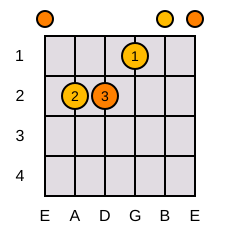
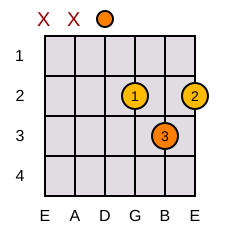
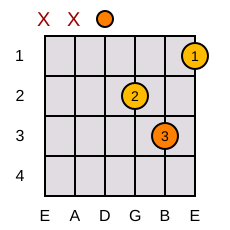
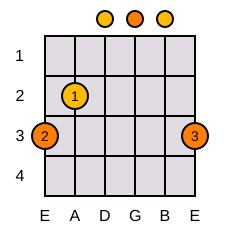
- E minor: two notes on fret 2, and all six strings ring.
- A minor and E major: the same shape, one string apart.
- D major and D minor: strum only the top four strings.
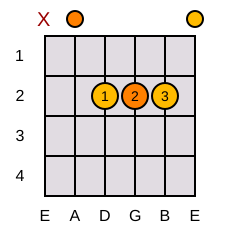
- A major: three fingers side by side on fret 2.
G, C, D and Em are the I, IV, V and vi chords of the key of G, so those four play many songs together. Change between two of them slowly before you add a third.
After the Open Chords
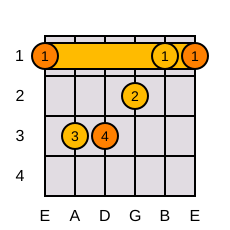
F major is usually played as a barre chord: the index finger lies across all six strings at fret 1. Move the same shape up the neck and it plays a major chord on whatever note is on the low E string.
Guitar Chord Types
A chord type is a formula: the steps of the major scale the chord takes, counted from the
root.  Info shows them for any chord as Steps. These are the nine most used:
| Chord type | Name | Steps | On C |
|---|---|---|---|
| Major | Major | 1-3-5 | C E G |
| Minor | Minor | 1-b3-5 | C Eb G |
| 7 | Dominant seventh | 1-3-5-b7 | C E G Bb |
| m7 | Minor 7th | 1-b3-5-b7 | C Eb G Bb |
| maj7 | Major 7th | 1-3-5-7 | C E G B |
| sus4 | Suspended 4th | 1-4-5 | C F G |
| sus2 | Suspended 2nd | 1-2-5 | C D G |
| 5 | Power chord | 1-5 | C G |
| dim | Diminished | 1-b3-b5 | C Eb Gb |
Guitar Chord Questions
How Many Guitar Chords Are There?
The Chord Finder has 50 chord types on each of the 12 notes: 600 chords, in over 2,700 shapes.
Why Does a Chord Have Several Shapes?
The same notes can be played in more than one place on the neck, and each place has its own fingering and its own sound: fuller near the nut, tighter higher up. A chord here has between 1 and 10 shapes.